

A limp on its own will not tell you what is torn inside your dog's knee. Confirming a cruciate ligament injury, the dog version of a human ACL, takes a hands-on knee exam that checks for a telltale looseness in the joint, plus X-rays that show how much arthritis has already built up. That matters most with partial tears, because your dog can seem better after a week of rest and still have a knee that is quietly giving way. What the exam and the images show together is what decides whether rest and rehabilitation are reasonable or surgery is the more durable repair.
South Shores Pet Clinic in San Pedro keeps digital X-rays in the same building as the suite where we perform cruciate ligament repair and TPLO surgery, so the imaging and the plan that follows stay under one roof. Walk-ins are welcome, and a back leg your dog will not put weight on is the kind of case we move up the day's schedule. You are allowed to want certainty before you commit your dog to surgery, and that starts with one knee exam, so if the limp has gone on more than a day or two, have us check that knee.
Four Things to Know About a Torn Knee
- A hands-on knee exam paired with X-rays confirms a cruciate tear, because the ligament itself doesn't show up on an X-ray.
- Most tears in dogs come from slow ligament breakdown, so the leg can fail during an ordinary turn in the yard rather than a dramatic accident.
- A torn cruciate won't knit back together, and a knee that keeps shifting builds arthritis faster than a stable one.
- Surgery gives most medium and large dogs the better long-term result, while some very small dogs do reasonably well with strict rest and rehabilitation.
Why Did My Dog's Knee Give Out During an Ordinary Run?
A cruciate ligament injury in a dog is usually the end of a slow process: the ligament fibers weaken over months, and the ball-chase across the yard is only the day the leg finally gives out. A tear that follows one genuinely bad step is the exception rather than the rule.
- Breed and build: Rottweilers, Labradors, Newfoundlands, and Staffordshire Terriers carry more of this risk than most, and small dogs are not exempt.
- Tibial plateau angle: the top of the shin bone is sloped, and a steeper slope means more force pushing the shin bone forward with every stride.
- Body condition: extra weight is linked to increased risk, and annual wellness exams are where we track weight, score muscle condition, and talk through how much hard running your dog's knees can take.
- Activity pattern: the dog who's sedentary all week and then does hard pivots at the park on Saturday is a classic pattern, and San Pedro's mild winters mean it runs year round instead of pausing for a season. Slick floors and repetitive ball-chasing add to the risk.
Once one cruciate tears, the risk to the opposite leg goes up substantially. Many dogs end up tearing both cruciate ligaments within a year or two of the first tear. The same factors affecting the first also wear down the second, and the compensation from limping adds even more strain.
Which Signs Point to a Torn Knee Ligament and Not a Pulled Muscle?
Limping that eases after a few quiet days and comes right back the first time your dog sprints is the classic pattern of a partial tear. A complete tear behaves differently: the leg goes down mid-stride and stays unusable. A strained muscle, by contrast, keeps getting better.
Not every back-leg limp is the cruciate. A sprain, a fracture, hip dysplasia, a slipping kneecap, and in older large-breed dogs a bone tumor can all make a dog refuse to load a leg, which is why the exam comes before the plan. What families notice at home tends to be one of these:
- Toe-touching: the foot rests on the ground but carries almost no weight.
- The sit: your dog sits with the sore leg kicked out to the side instead of tucked under.
- Hesitation: stairs, the car, and the back of the couch suddenly require a pause.
- Swelling: a thickened, firm feel on the inside of the knee compared to the other side.
- Stiffness after rest: a big afternoon followed by a hard time standing up the next morning.
- Clicking or popping: an audible catch in the joint, which can mean the meniscus has torn too.
Any two of these together is worth an appointment, and waiting for a full three-legged hop usually means more joint damage by the time we see the knee.
What Happens at the Vet When My Dog Won't Put Weight on a Back Leg?
A back leg your dog won't use gets a full orthopedic exam first, with both knees compared side by side, and then imaging. Pain control can start at that visit, before every answer is in. Bring a phone video of how your dog moves at home, since a dog who is tense in an exam room often walks better or worse than they do in their own yard.
- The walk down the hallway: we watch which leg unloads, how the hips sit, and whether your dog has shifted weight onto the front end.
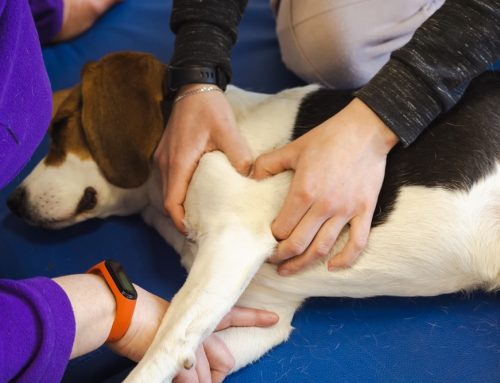
- The knee exam: the key test is feeling whether the tibia, the shin bone, slides forward under the thigh bone in a way a healthy knee won't allow. A sore, tense dog may need sedation before that looseness can be felt reliably.
- The opposite knee: the good-looking leg gets the same exam, as a comparison and because second tears are common.
- X-rays: these show the bones of the knee and how much arthritis has already set in, which tells us whether this knee has been loose for months or gave out last Saturday.
- MRI: this shows the ligament and the meniscus directly in a way X-rays cannot, but it means a trip to a specialty hospital and is reserved for the rare knee that doesn't add up on exam and X-rays.
Our veterinarians are also judging how much of the ligament is left and whether the meniscus is torn too, since those two answers shape which repair makes sense.
Does This Knee Need Surgery, or Can We Treat It Another Way?
A torn cruciate is treated one of two ways: stabilizing the knee surgically, or managing it without surgery through strict confinement, pain control, and rehabilitation. Your dog's size, age, activity level, and the slope of the top of the shin bone decide which route fits, and that decision usually comes out of the first exam and the first set of X-rays.
- Rest and rehabilitation: very small, less active dogs, and dogs whose health rules out anesthesia. It takes strict confinement, anti-inflammatory and pain medication, and controlled rehab exercise, and the knee is still mechanically loose at the end of it.
- Extracapsular repair: smaller and moderately active dogs. Heavy suture outside the joint holds the knee steady while scar tissue builds, so recovery runs weeks of strict rest and then a slow muscle rebuild.
- TPLO: active dogs and most medium, large, and giant breeds. The top of the tibia is cut, rotated, and plated so the slope no longer drives the joint forward, and weeks of strict rest lead into a staged rebuild with X-rays confirming the bone has healed. TTA is a second similar option used for some dogs.
Can a Torn Cruciate Heal With Rest Alone?
Rest can quiet the soreness, but it won't rebuild a torn cruciate or make the knee stable, and it can't stop the damage the instability keeps causing. An unstable knee shifts with every step, and that is what months of waiting cost:
- Faster arthritis: arthritis advances more quickly in a joint that cannot hold itself steady.
- A thickened joint capsule: the capsule scars down over time, which adds a little stability and costs range of motion.
- A torn meniscus: the cartilage cushion between the bones can tear as it gets pinched by a knee sliding where it shouldn't, and that new injury usually brings a sudden return of severe lameness in a dog who seemed to be improving.
- Muscle loss: the hindquarters thin out over weeks of disuse, so a dog who has limped for six months has less to work with in recovery than one repaired early, and the good leg carries extra load the whole time.
For a 12-pound dog, the forces crossing that knee are small enough that scar tissue can sometimes do an acceptable job, though it still means weeks to months of real confinement, pain medication, and controlled exercise. For most medium, large, and giant breeds, the knee holds up better over the years after surgery, and arthritis progresses more slowly than it does with rest alone. The split isn't clean: a small dog with a torn meniscus, one who's still painful after a fair trial of rest, or one who won't tolerate confinement can end up needing surgery anyway.
Never give your dog human pain medication. A dose of ibuprofen, naproxen, or acetaminophen that looks harmless on the label can cause stomach ulcers, kidney failure, or liver damage in a dog. Call us and we'll get a dog-safe anti-inflammatory into the plan instead. If a limp has been coming and going for a few weeks, reach out rather than giving it another month.
How Do TPLO, TTA, and Extracapsular Repair Differ?
TPLO surgery cuts and rotates the top of the shin bone to flatten its slope, so the knee stays steady without a ligament doing the work, and it's the usual recommendation for active and large-breed dogs. A tibial tuberosity advancement, or TTA, changes the mechanics at a different point on the same bone and suits some dogs' anatomy better. An extracapsular repair runs heavy suture outside the joint instead, which can be a reasonable choice for a smaller, moderately active dog.
Which of the three fits your dog turns on size, the slope measured on those X-rays, and what the meniscus looks like once we've examined the knee. You'll know before you leave that first visit whether the orthopedic surgery your dog needs is one we take on here or one that belongs with a boarded surgeon, and either way, hospitalization for a cruciate repair is usually short and the pain control plan goes home with you for that first week.
What Is the Recovery Timeline After Knee Surgery?
Rehabilitation moves in stages, and your dog's exact schedule comes from the surgeon who did the work.
| Stage | What's happening inside the knee | What your dog can do |
| First couple of weeks | Incision closing, with the plate or suture under its heaviest strain | Confinement, short leash trips for bathroom breaks, gentle range-of-motion work at home |
| Weeks three to six | Bone or scar tissue gaining strength while the thigh muscle is still thin | Flat, slow leash walks lengthening gradually, with no stairs, jumping, or off-leash time |
| Around two to three months | Healing confirmed on recheck, muscle rebuilding in earnest | Longer walks, gentle inclines, controlled strengthening work |
| Beyond that | Arthritis management becomes the long-term job | Most normal activity returns, with hard pivots and repetitive ball-chasing added back cautiously |
Dogs recovering from a knee repair compensate through the back, hips, and opposite leg, which is where chiropractic care and laser therapy on the joint fit alongside a home exercise program. Formal rehabilitation centers add underwater treadmills and therapist-guided exercise, which some recoveries need. Call us if the incision swells, reddens, or starts to drain, or if your dog suddenly stops using a leg that had been getting better.
What Will I Need to Do at Home While My Dog Heals?
Most of the treatment happens in your living room: confinement that actually gets enforced, no couch launches, and a routine your dog can predict. The first six weeks shape the result more than anything else.
How Do I Keep My Dog Calm on Crate Rest?
A dog who feels better at week two doesn't understand why the yard is suddenly off limits, and that's usually when setbacks happen. Confinement protects the repair from the one bad jump that undoes it, so it isn't negotiable in the early weeks. Crate rest is easier on everyone when the crate sits where the family spends its evenings, and snuffle mats, frozen stuffed toys, short training sessions done lying down, and a rotation of safe chews burn real mental energy without loading the knee.
How Do I Protect That Knee for the Long Run?
A dog carrying extra weight loses mobility faster, which is why staying lean protects a knee better than a supplement can. Lean is a specific number rather than a feeling, so ask us about a safe weight target and the daily calorie total that gets your dog there, treats included.
Warm-ups and cooldowns of a few minutes of easy walking settle the soft tissue around a joint already injured once. Runners on hardwood and a rug at the bottom of the stairs stop the scrambling that re-injures a knee, and lifting a big dog into the car, or using a ramp, removes the hardest movement of their day. The hills around San Pedro make good conditioning once your dog is cleared for them, as long as the climb stays steady. Jot down each day's activity and how stiff your dog is the following morning, and we'll use that log at rechecks to decide what to add back.
Common Questions About a Torn Cruciate Ligament
Will my dog get back to full activity after a knee repair?
Most dogs return to full or near-full function after a stabilizing surgery, and plenty of sporting and working dogs go back to their jobs. The realistic goal is comfortable and active rather than good as new: arthritis is already in that joint, so a hard weekend can still mean a stiff Monday years later.
Is my senior dog too old for knee surgery?
An older dog can be a good surgical candidate, because overall health decides this far more than the number of birthdays. We start with bloodwork, and a dog with a heart murmur may also need an echocardiogram, an ultrasound of the heart, before anesthesia. A fit eleven-year-old can be a better candidate than a seven-year-old with kidney disease, and for an older dog with significant arthritis elsewhere, rest and good pain control is sometimes the kinder plan. We'll lay out both honestly.
If one knee tore, will the other one go too?
The risk to the second knee is meaningfully higher after the first tear, since the same slope, build, and activity pattern apply to both legs. It isn't a certainty, and many dogs never tear the other side. Watch that leg for the same early signs, especially a limp that improves with rest and returns with running.
Keeping Your Dog's Knee Working in San Pedro
Plenty of the dogs we see on the Friendship Park trails and along the Cabrillo Beach path tear a cruciate on one hard turn, and most of them get back to those walks with the right care. Schedule an appointment at South Shores Pet Clinic and we'll examine that knee and develop a plan together.

Leave A Comment